Home › The method
The method
From plot coordinates to a filed statement you can defend.
You import the coffee or cocoa; the filing duty is yours. We carry the whole due diligence behind it (the information, the deforestation assessment, the risk, and the filing), so a legal obligation becomes a short, repeatable routine.
The full obligation
Due diligence is more than a satellite check. We carry all of it.
EUDR due diligence has three parts the regulation is explicit about: collect the information on your supply chain, assess the risk it carries, and act on that risk before you file. Most tools stop at a map. We run the whole process end to end, and the filed statement is the last step, not the only one.
We build your due-diligence file. Art 9
The products and quantities, the country and plots of production, the production period, your suppliers, your import and EORI details. You bring the source information (the geolocation your producers hold and the documents only your suppliers can provide), and we assemble it into the record the regulation expects: structured, complete, and ready to defend.
We assess every plot for deforestation. the hard part
Each plot is cross-read against three authoritative datasets to help distinguish genuine post-2020 forest conversion from the ordinary management of shade-grown coffee and cocoa: the distinction a single map cannot make on its own, and the part we built glebora around. Our assessment is type-aware, and anything ambiguous goes to a person, not an automatic verdict. Every result records the exact datasets and versions it relied on.
We structure and assess your legal-production evidence. Art 9 · legal production
The regulation also asks whether your coffee or cocoa was produced legally: land-use rights, environmental rules, third-party and labour rights in the country of origin. You supply the documents your suppliers hold; we organise them into your file, assess what they show, and flag what’s missing or weak. You’re never left to work out what “evidence of legal production” means on your own.
We weigh the risk, and tell you what to close. Art 10-11
The whole picture becomes a documented risk assessment. Where the risk isn’t negligible, we tell you precisely what needs closing and how, because a statement filed over an open risk is a statement that won’t hold. We file when it’s ready to stand up.
We file as your Authorised Representative, and hand you the record.
We submit the DDS in the EUDR Information System (the EU’s EUDR filing system within TRACES) under your operator identity, retrieve the reference number your buyers and the authorities can ask for, and hand you the complete, cross-referenced dossier behind it: the answer, already written, for the day a Competent Authority asks how you concluded no or only negligible risk was found. We file with your operator identity in the payload, never our own.
You bring your supply chain. We carry the due diligence, not a dashboard that leaves the hard parts on your desk.
The assessment
Why one map isn’t enough for coffee and cocoa.
Coffee and cocoa are often grown under shade trees. To a single satellite map, the pruning and replanting of those shade trees can look like forest loss, and a naïve one-map overlay will flag a perfectly legal agroforestry farm as a problem.
We cross-read several authoritative sources instead of trusting one. A baseline forest map sets the 2020 line; a change layer shows disturbance since; and a third classifies whether that disturbance was actual deforestation or the ordinary management of a tree-crop system. Confirmed post-2020 conversion is flagged with the evidence behind it; anything ambiguous is surfaced for a human to look at, never silently passed or silently failed.
How we read the evidence
Real forest data
We read the real forest behind your beans.
What you receive
A record you can hand to an auditor, not a report to decode.
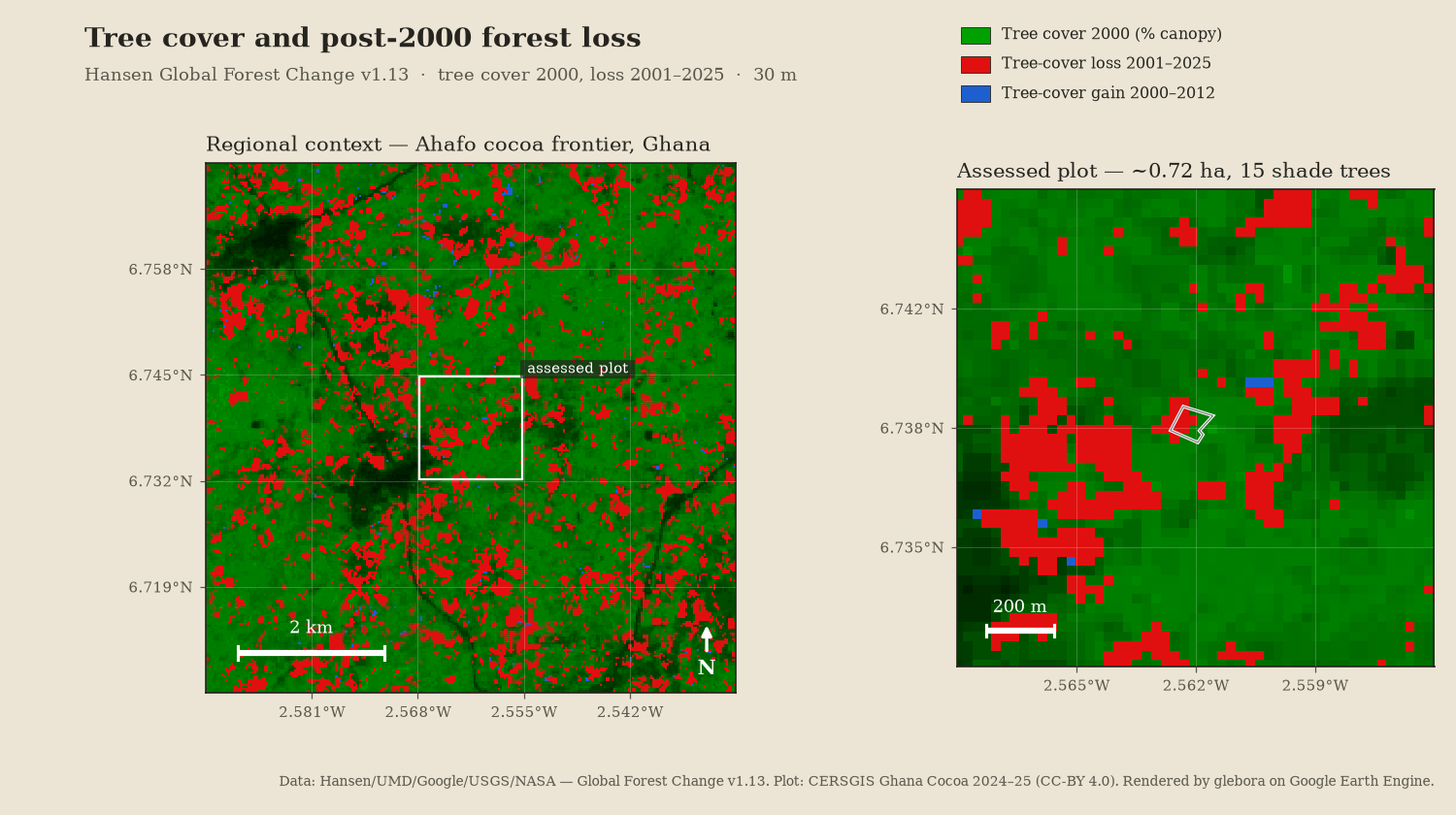
Every plot comes back as a plain record: what was checked, what the sources said, and a clear verdict, with anything ambiguous held for a person rather than force-passed or force-failed. Below is real, unedited output from our engine: two public reference plots, run and rendered field for field.
- Baseline
- 31 Dec 2020
- Analysis
- plot boundary, post-2020
- Datasets
- GFC2020 · Hansen v1.13 · TMF 2025
Plots assessed: 2
| Finding | Method / dataset | Result | Reading |
|---|---|---|---|
| Tree-cover loss, post-2020 | Hansen GFC 2025 v1.13 | 0.35 ha | Disturbance signal, not itself deforestation |
| Confirmed deforestation | JRC TMF vs 2020 baseline | 0.00 ha | No TMF-confirmed forest conversion |
Held for human review. Satellite shows 0.35 ha of tree-cover loss since the cut-off, but cross-checking with JRC TMF confirms none of it is forest conversion, consistent with the ordinary management of a shade-grown farm. Surfaced to a person, not auto-failed.
| Finding | Method / dataset | Result | Reading |
|---|---|---|---|
| Tree-cover loss, post-2020 | Hansen GFC 2025 v1.13 | 0.00 ha | None detected |
| Confirmed deforestation | JRC TMF vs 2020 baseline | 0.00 ha | No forest conversion |
Pass. No post-2020 tree-cover loss on any source. Clears without needing human review.
Datasets & method
- Baseline map
- JRC Global Forest Cover 2020, Copernicus JRC/GFC2020/V3
- Loss detection
- Hansen Global Forest Change 2025, CC-BY 4.0 v1.13
- Conversion class.
- JRC Tropical Moist Forest, 2025 release JRC/TMF/v1_2025
- NRT alerts
- RADD / WUR Sentinel-1 forest disturbance, CC-BY 4.0
- Criteria
- Reg. (EU) 2023/1115 Art. 2: forest ≥0.5 ha / ≥5 m / ≥10% canopy; cut-off 31 Dec 2020
- Method
- Type-aware cross-validation: TMF-confirmed conversion flags; unclassified loss held for review
Filing
Once a plot clears, we file the Due Diligence Statement in the EUDR system as your Authorised Representative, under your operator identity and EORI. TRACES issues the DDS reference and verification number on submission; you keep the whole dossier (plot geometry, assessment, evidence and reference) for the five years the regulation requires.
- DDS reference
- 26DK0KD5X095AP
- Verification no.
- 22NXW0L5
- Status
- AVAILABLE
- Filed as
- Authorised Representative: operator identity in the payload, never ours
- Operator
- Provenleaf Coffee ApS · EORI DK39184756
- Submitted
- 31 Jul 2026
The coffee plot above cleared, so we ran it end to end through the European Commission’s EUDR Acceptance environment: the official replication system that mirrors production TRACES but issues test statements, not legally valid ones. This is a genuine sandbox submission that proves the filing path works, not a client filing. Live filings are made only on production TRACES, under a signed mandate.
Real, unedited output from our deforestation engine, run on two public reference plots. The Ghana plot is a public reference farm, not a client plot: CERSGIS, Reference Dataset for Land Use Change Mapping in Ghana’s Cocoa Landscape (2024-2025), Zenodo doi:10.5281/zenodo.15778396 (CC-BY 4.0). The DDS reference shown was issued by the EU’s EUDR Acceptance (replication) environment: a real test submission, not a live client filing. The due-diligence declaration, and legal liability for it, remain with the operator.
Keep this as a standalone due-diligence file you can print or share →
Last legally checked: 27 August 2026. Source: Regulation (EU) 2023/1115 (consolidated) and European Commission guidance.
Get in touch
Ready when you are.
Tell us what you import and where from, and we’ll show you exactly what your filing would involve.